
Car parts explained for gamers: what real parts do in car games
Car games ask you to fit batteries, change spark plugs, and patch tires. This guide explains what seven real car parts do, what happens when each part fails, and how car games turn the part into gameplay. When you know the real part, the game part makes more sense.
Battery
In a real car: Most cars use a 12-volt battery. It gives the power to crank the engine when you start the car. When the engine runs, the alternator takes over the electrical load and recharges the battery.
When it fails: The engine does not crank, or it cranks too slowly to start.
In games: In My Summer Car, you install the battery in your car yourself, and the alternator charges it when the engine runs. In Pacific Drive, the headlights take power from the battery, and you recharge it at a charging station in your garage.
Alternator
In a real car: The alternator is a small generator. A belt from the engine turns it. It makes alternating current, and diodes change this to direct current. A voltage regulator keeps the voltage steady. The alternator powers the lights, the radio, and other electrical parts, and it recharges the battery.
When it fails: The symptoms look like a dead battery, because the battery does not get a charge. Lights can become dim, and a battery or charge warning light can come on.
In games: My Summer Car models the alternator and its belt. In that game, the same belt also turns the water pump. You set the belt tension when you move the alternator, and a belt that is too tight can break.
Radiator
In a real car: The radiator is a part of the cooling system. A coolant, which is a mix of water and antifreeze, flows through the engine and absorbs heat. A water pump moves the coolant, and a thermostat controls the flow. In the radiator, thin tubes and metal fins pass the heat to the air. A fan moves air through the fins when the car moves slowly or stops.
When it fails: The engine can overheat.
In games: In Jalopy, you must keep fuel, oil, and coolant in the car. In My Summer Car, the radiator and its hoses are separate parts that you bolt into place.
Spark plugs
In a real car: A gasoline engine cannot ignite its fuel by compression alone. In each cylinder, a spark plug makes a spark that ignites the mix of air and fuel. A diesel engine works differently. It compresses air until the air is hot enough to ignite the fuel, so it has no spark plugs. Some diesel engines use glow plugs to help them start in cold weather.
When they fail: Worn spark plugs make weak sparks. The engine can be hard to start, idle roughly, or misfire. Fuel economy can also become worse.
In games: In My Summer Car, you put the spark plugs into the cylinder head yourself. In Jalopy, the ignition coil is one of the parts that wear out. In a real car, this coil makes the high voltage for the spark.
Fuel pump
In a real car: The fuel pump moves fuel from the tank to the engine at the correct pressure. Older cars with a carburetor often used a mechanical pump on the engine. Modern cars with fuel injection need a higher pressure, so they use an electric pump. This pump is often inside or near the fuel tank.
When it fails: The engine gets no fuel. It does not start, or it stops when you drive.
In games: My Summer Car has a fuel pump that you bolt to the engine. In The Long Drive, the fuel level is what matters, and the Steam page says that a full tank lasts about 500 km. In Route 48, you manage your fuel and scavenge for more.
Tires
In a real car: The tires are the only part of the car that touches the road. Correct pressure and enough tread give the grip that you need when you steer and brake. The recommended pressure is in the owner's manual or on a label on the driver's door frame. Most tires have small raised bars in the tread grooves. When the tread wears down to these bars, you must replace the tire.
When they fail: Worn tread gives less grip, mostly on wet roads. A puncture can stop the car.
In games: In Pacific Drive, the wheels can take damage, and you repair holes in the tires with a sealing kit. In Jalopy, the tires are one of the parts that you repair or replace on the trip.
Headlights
In a real car: Headlights have two settings. The low beam is for normal use at night. The high beam reaches farther, but it can dazzle other drivers. Use it only when no other traffic is near. Common bulb types are halogen, HID (xenon), and LED. A halogen bulb uses a hot filament. An HID bulb makes light with an electric arc.
When they fail: You see less of the road at night, and other drivers see less of you.
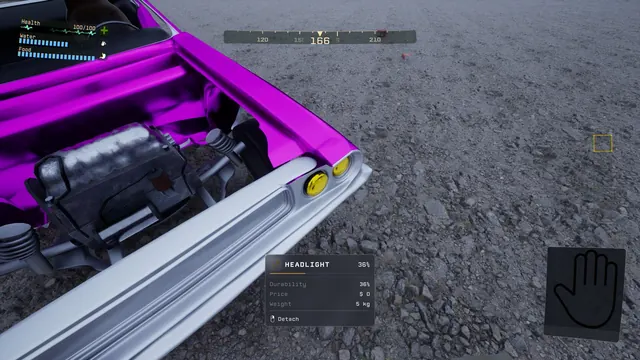
In games: In Pacific Drive, the headlights use battery power, so lights that stay on can drain the battery. In Route 48, the headlight is a part on the car. One of our screenshots shows the car with its hood open while the player selects the headlight part.
How car games use real parts
Car games use these parts in three main ways:
| Style | How parts work | Examples |
|---|---|---|
| Simulation | You fit or replace each part by hand | My Summer Car, Car Mechanic Simulator 2021 |
| Road trip | The car needs fuel and care on a long trip | Jalopy, The Long Drive |
| Survival | Damaged parts can end your trip | Pacific Drive, Route 48 |
In a simulation game such as Car Mechanic Simulator 2021, the part is the goal. You find the worn parts and replace them. In a road trip game, the part is a constant cost of the journey. In a survival game, the part is a resource. You must find it, carry it, and fit it before danger arrives.
For more games of each style, see our list of the best car repair games on PC. If you like to build a car part by part, read our list of games like My Summer Car.
How Route 48 uses car parts
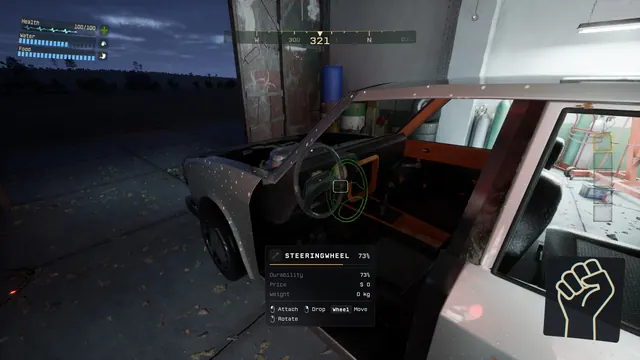
Route 48 is our first-person driving survival game. You scavenge for fuel and parts, repair damaged parts, and make sure that your car continues to run. A broken vehicle can mean the end of your journey, but you can continue on foot. In one of our screenshots, the player fits a steering wheel to a car in an abandoned garage. The game is in Early Access, and more vehicle parts and customization are planned for the full version.
To learn more about the genre, read what a driving survival game is.